
FMCG pricing strategy
for food & drink brands
Pricing is the most powerful lever in FMCG marketing and often the most underused. Get it right and you fund growth, protect margin and earn retailer support. Get it wrong and even a brilliant product stalls on shelf. At Big Black Door, we’ve helped numerous food and drink brands build a pricing strategy that is simple, defensible and built for growth. With decades of experience across brands like Weetabix, Heineken and Arla, we’ve learned that the best FMCG pricing isn’t about being cheapest, it’s about being clear on the value you offer and who you offer it to.
Pressure test your FMCG pricing before your next retailer conversation
For food and drink brands preparing for launch, range review, price increase or retailer negotiation. We help you check your RRP, trade price, retailer margin story and pack architecture before costly decisions get locked in.
In 30 minutes, we’ll help you identify whether your current price is commercially robust, retailer-ready and defensible
THIS IS FOR YOU IF:
| Situation | Why pricing needs attention |
|---|---|
| You are launching into grocery | You need an RRP, trade price and retailer margin story that makes commercial sense. |
| You are preparing for a range review | You need to defend price, value, rate of sale and margin with confidence. |
| Costs have gone up | You need to know whether to increase price, change pack size, adjust margin or absorb the pressure. |
| You are too dependent on promotions | You need to protect margin without training shoppers to only buy you on deal. |
| You are premium-priced | You need to prove that the value is visible, credible and strong enough to justify the price. |
Pricing experience across major & challenger brands
We’ve worked across brands including Weetabix, Heineken, Arla, Bold Bean and Spoon Cereals, helping teams make clearer decisions on pricing, positioning, retailer growth and marketing strategy. For example, a launching food brand needed to understand whether its super premium price was going to be a significant barrier to purchase. We reviewed category pricing, pack-size comparisons, margin structure and shopper value claims, then built a clear pricing story for retailer conversations along with uncovering the purchase drivers that best delivered the premium.
What is FMCG pricing strategy?
FMCG pricing strategy is the process of setting and managing the trade price, recommended retail price, promotional price and pack-price architecture for a fast-moving consumer goods product. A strong FMCG pricing strategy balances shopper value, retailer margin, category context, brand positioning and the brand’s own profitability.
SOME OF THE BRANDS WE’VE HELPED









What is FMCG pricing strategy?
FMCG pricing strategy is the process of setting and managing the trade price, recommended retail price, promotional price and pack-price architecture for a fast-moving consumer goods product. A strong FMCG pricing strategy balances shopper value, retailer margin, category context, brand positioning and the brand’s own profitability.
Why FMCG pricing strategy matters more than you think
In food and drink, a few pence either way can decide whether a product is profitable, whether a retailer backs it, and whether shoppers pick it up. Pricing affects three things at once:
Margin: the money you keep to reinvest in growth.
Retailer relationships: buyers need to see a price that works for their category and their shopper.
Brand perception: price signals quality. Too low and you cheapen the brand; too high without justification and you lose the sale.
A deliberate, confident, considered pricing strategy, reviewed as you scale, is one of the fastest routes to healthy growth.
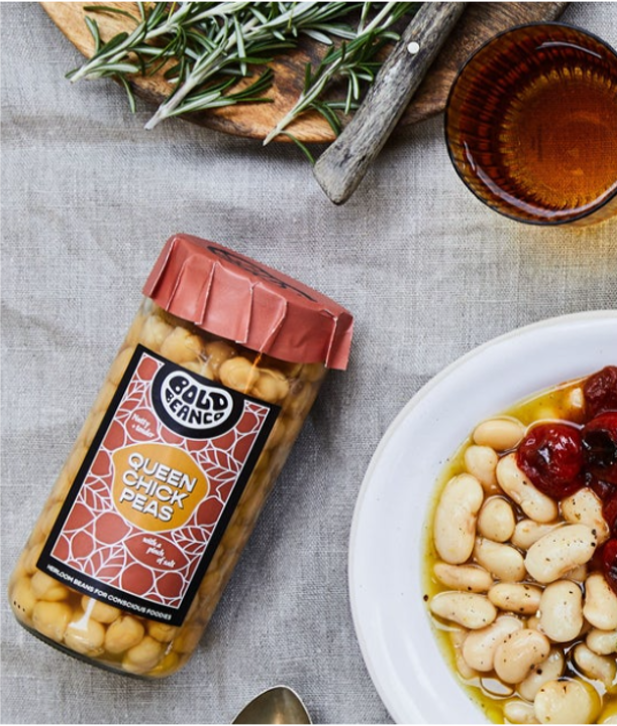
Finding the magic bean.
We helped Bold Bean research their phenomenal baked beans as they were preparing for launch.
Pressure-test your RRP, trade price, retailer margin story and pack architecture before your next retail conversation.
FMCG pricing models: the main approaches
There’s no single right answer: the best approach depends on your category, your costs and your ambition. These are the pricing models we help food and drink brands weigh up:
Cost-plus: You add a set margin on top of your costs. Simple and safe, but it ignores what shoppers will actually pay and what competitors charge. A useful starting point, rarely the best finishing point.
Value-based: You price according to the value shoppers place on your product, not just what it costs to make. This is where premium and challenger food and drink brands win: if you can clearly justify the value, you can command the price.
Competitor-based: You set price relative to the alternatives on shelf. Important to understand, but dangerous to follow blindly as it could drag you into a race to the bottom that destroys category value.
Price-pack architecture (PPA): Rather than one price, you design a range of pack sizes and price points for different shoppers and occasions. Done well, this is one of the most effective tools in FMCG for growing volume and value for the brand and category.
Who actually sets the price? Understanding retailer dynamics
Brace yourself - it’s not you. In most markets, the retail price is at the sole discretion of the retailer. You set your trade price (what you sell to the retailer for); they decide what to charge the shopper.
That makes the conversation with your buyer one of the most important you’ll have. Your job is to build a pricing and margin chain that works for your retail partners. Showing them how your product earns its place in the category and delivers the margin they need while protecting enough margin for your own business to grow. Getting this balance right is where experienced FMCG pricing support pays for itself.
When should an FMCG brand review its pricing?
FMCG pricing should not be reviewed only when costs go up. Pricing affects margin, retailer support, shopper perception, rate of sale and long-term brand value. If your price no longer reflects your costs, your positioning or the reality of the category, it is time to take another look.
A pricing review is especially important when:
Your ingredient, packaging, freight or manufacturing costs have increased
A retailer range review is coming up
You’re moving from DTC into grocery, wholesale or convenience
You’re launching a new pack size, format or multipack
Your brand is becoming too dependent on promotions
Retailers are pushing for more margin or stronger commercial terms
You’re premiumising, repositioning or changing your brand architecture
Competitors have changed price, pack size or promotional mechanics
Trial is strong but repeat purchase is weaker than expected
The earlier you review pricing, the more options you have. Leaving it too late often forces brands into blunt price increases, margin erosion or reactive promotions. A good FMCG pricing strategy gives you a clearer view of what shoppers will accept, what retailers need, and where your brand can make money without damaging demand.
FMCG pricing strategy for retailer negotiations
Retailer pricing conversations are rarely just about the number on shelf. Buyers want to understand whether your product can grow the category, deliver sufficient margin, drive rate of sale and give shoppers a reason to choose it over the alternatives.
A strong FMCG pricing strategy helps you go into those conversations with a clearer commercial argument.
What buyers care about
Retail buyers are usually looking at several things at once:
Will the product grow the category or simply take sales from existing lines?
Is the retailer margin attractive enough?
Does the Manufacturer’s Recommended Retail Price (MRRP) make sense against competitors?
Will shoppers understand the value quickly?
Can the product sustain rate of sale after launch?
Is there a credible promotional plan?
Does the pack size, format and price point fit the shopper mission?
If your pricing story only explains your costs, it is unlikely to be enough. You need to show why the product deserves its price and how that price works for the retailer, the shopper and the category.
How to justify RRP
A recommended retail price should be based on more than the margin you want to make. It should reflect the product’s role in the category, its quality cues, brand positioning, pack size, usage occasion and competitive set.
For premium products, the job is to show why the higher price is credible. That might come from ingredients, provenance, functionality, brand strength, format, convenience or a clear shopper need. For mainstream products, the job is often to show that the price is competitive without giving away unnecessary margin.
The goal is not just to pick an RRP. The goal is to build an RRP you can defend.
How to protect margin
Margin protection starts before the retailer conversation. You need to understand the relationship between trade price, expected shelf price, promotional price, retailer margin and your own contribution margin. Without that view, brands can agree to terms that look acceptable at launch but become painful once promotions, logistics, marketing support and retailer requirements are included. A better approach is to model the commercial picture before negotiations begin. That gives you a clearer view of where you can flex, where you need to hold firm, and which price points are commercially dangerous.
How to frame category value
Retailers need a reason to believe the product will improve the fixture. Your pricing strategy should help explain how the product adds category value. That could mean attracting a higher-spending shopper, trading consumers up, filling a price gap, improving choice, creating a new usage occasion or bringing stronger brand energy to the shelf. When price is connected to category growth, the conversation becomes less defensive. You are no longer just explaining why the product costs what it costs. You are showing why the retailer should want it in the range and how it will make them more money.
How to handle “you’re too expensive”
“You’re too expensive” doesn’t always mean the price is wrong. It can mean the value is unclear, the pack comparison is unfavourable, the buyer is testing your confidence, or the retailer economics don’t work. The right response depends on the issue. Sometimes the answer is a sharper value story. Sometimes it is a different pack size. Sometimes it is a clearer promotional plan. Sometimes the trade price needs work. And sometimes the brand should hold its nerve because discounting would damage the positioning and margin. A good pricing strategy helps you know the difference.
How pricing links to rate of sale, promotions and retailer margin
In FMCG, price affects more than profitability. It influences how quickly the product sells, how often it is promoted, how shoppers perceive the brand and how much support a retailer is likely to give it. A price that is too high can slow rate of sale. A price that is too low can weaken brand perception and leave too little margin to invest behind growth. A promotional price that is too aggressive can train shoppers to wait for deals. A weak retailer margin can make the product harder to support in range. That’s why pricing, pack architecture, promotional strategy and retailer margin need to be considered together. The strongest pricing decisions are not just financially sound. They are commercially usable in real retailer conversations.
FMCG pricing strategy checklist
Before you commit to a price, make sure you’re clear on the following:
What is your trade price in to your retail partners?
What MRRP are you recommending?
What margin does the retailer make?
What contribution margin do you keep?
What happens at your promotional price?
What’s your blended or “Average Realised Price”?
Does the pack size make comparison easier or harder for shoppers?
Can you defend any premium?
How are you adding value to the category for your retail partners?
Will the price support repeat purchase?

How we help you build a pricing strategy
We use the same simple, three-step approach that’s worked for us in businesses from Heineken and Weetabix to scale-ups like Spoon Cereals:
Understand: your costs, margins, category, competitors and the value your product genuinely offers.
Decide: the right pricing model and price-pack architecture for where you want to play and grow.
Activate: a clear pricing and margin story you can take to retailers, with the confidence to defend it.
No jargon, no fluff: just a straightforward pricing strategy you can explain in a sentence and act on with confidence.
How to research the right price (before you commit)
Guesswork is the enemy of a robust pricing strategy. The good news is you don’t need a huge budget to research price properly, you simply need the right method for your stage. Here are some of the approaches available to food and drink brands, from quick and cheap to robust and rigorous.
1. Competitor and shelf analysis
Start by walking the category in store and online. Map every comparable product, its pack size, its shelf price and its price per 100g or per litre. This tells you the going rate and where the gaps are. It’s free, fast, and the essential first step before any survey: you can’t judge your own price without knowing the landscape your shopper sees. You can even get AI to do some of the heavy lifting for you.
2. Customer interviews and surveys
Talk to real or potential buyers. Open questions (“what would you expect to pay for this?”) give you a rough range and, more usefully, the reasoning behind it. This is qualitative so it won’t give you a precise number, but it surfaces how shoppers think about value in your category, which is gold when you come to justify your price.
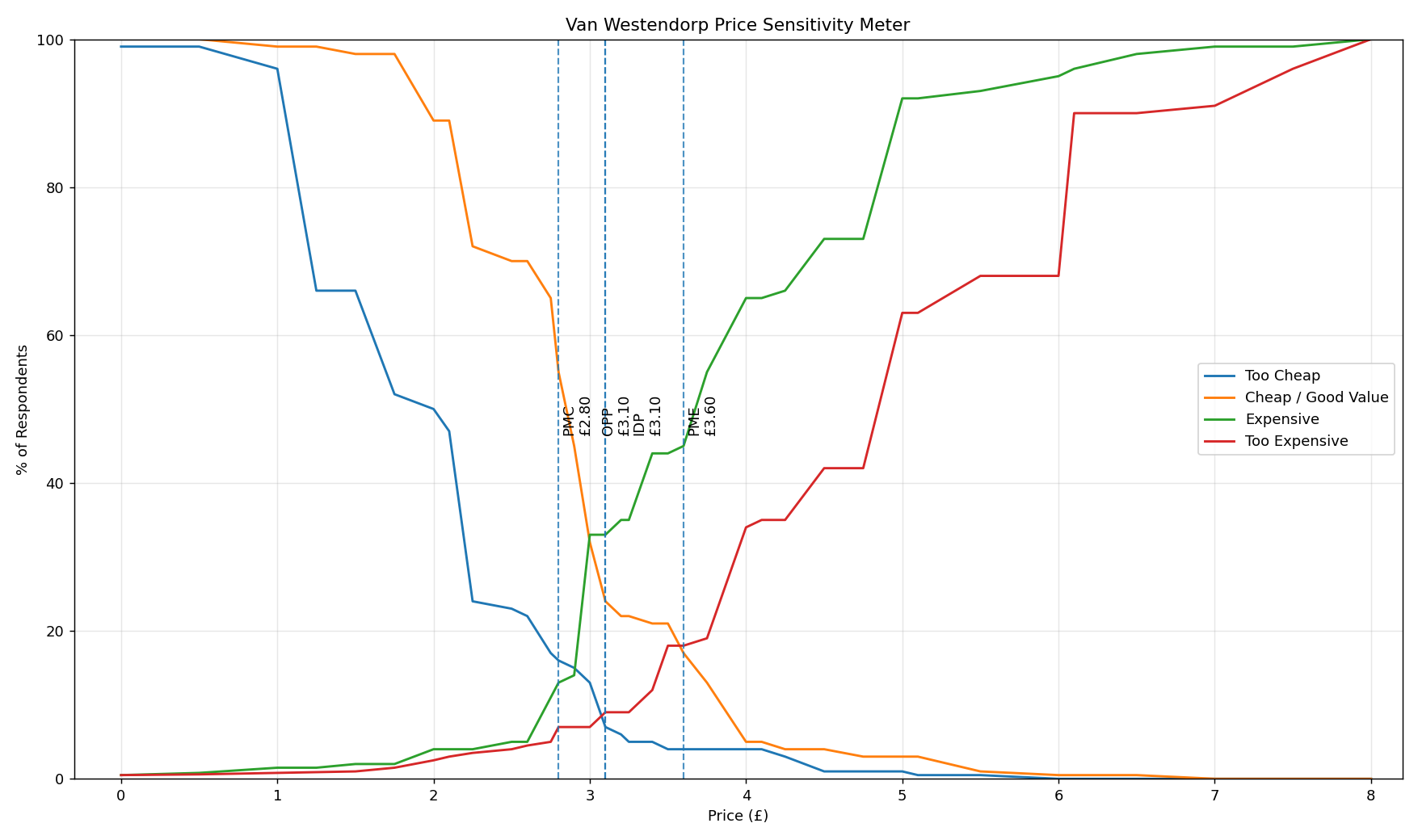
3. The Van Westendorp Price Sensitivity Meter
When you want a defensible price range backed by data, this is the classic FMCG method and it’s well within reach of a growing brand. Developed by Dutch economist Peter van Westendorp, it asks a sample of your target shoppers just four questions about your product:
a. at what price is it so expensive you would not consider buying it?
b. at what price does it start to feel expensive, but you’d still think about buying it?
c. at what price would it be a great buy for the money?
d. at what price would it be so cheap you’d question the quality?
You plot the cumulative responses to all four as lines on a chart, and where those lines cross tells you the acceptable price range and the sweet spot within it. Crucially, it captures something cost-plus pricing never can: the point where a low price actually damages trust in your product.
One important caveat: Van Westendorp tells you what shoppers say is acceptable, not how many will actually buy at each price. For that you can extend the method (adding purchase-intent questions) or pair it with a small sales test. We’ll help you choose the right level of rigour for the decision you’re making.
4. Live price testing
The ultimate test is real money. If you sell direct-to-consumer or through a channel you control, you can test different prices with real shoppers and watch what actually converts. It’s the most reliable signal of all: real behaviour beats claimed intent every time so use it to confirm what your research suggested before a full rollout.
Which method should you use?
For most growing food and drink brands we’d recommend starting with competitor analysis (always), adding a Van Westendorp study when a real pricing decision is on the line, and confirming with a live test where you can. You don’t need all four every time you need the right one for the size of the decision. That’s exactly the kind of call we help you make.
In 30 minutes, we’ll help you identify whether your current price, margin story or pack architecture is helping or holding back growth.
FMCG pricing: frequently asked questions
-
Start with the value you offer, not just your costs. Premium pricing works when shoppers can see and believe the reason for the higher price: better ingredients, provenance, taste, or experience. Make that value obvious on pack and in your marketing, then price to reflect it. A premium price with no visible justification simply gets left on shelf.
-
In most cases, the retailer does. You set the trade price you sell to them at; the final shelf price is at the retailer’s discretion. That’s why your pricing and margin story to the buyer matters so much: it shapes the price they choose to set.
-
At least annually, and whenever your costs, competitors or ambitions change significantly. Many growing brands set and forget. Regular review is one of the simplest ways to protect margin and unlock growth.
-
Start by mapping competitor prices across the category, then test shopper perceptions with research. The Van Westendorp Price Sensitivity Meter is a popular, affordable FMCG method: you ask target shoppers four questions about your price and plot the answers to find an acceptable range and an optimal price. Where you can, confirm it with a live price test on real buyers. Match the depth of research to the size of the decision.
-
If pricing decisions feel like guesswork, if your margins are under pressure, or if you’re heading into retailer negotiations, an experienced second pair of eyes usually pays for itself. We help you make confident, defensible pricing decisions quickly and without jargon.
Common FMCG Pricing Mistakes:
The most common FMCG pricing mistakes are not mathematical errors. They are commercial judgement errors. Brands often price from cost alone, ignore retailer margin, follow competitors blindly, underprice premium products, use promotions to fix weak positioning, launch with the wrong pack size, fail to compare price per 100g or ml, and confuse trade price, RRP and promoted price.
Good pricing strategy avoids these traps by looking at the full commercial system: shopper value, retailer economics, pack architecture, promotional mechanics, brand positioning and margin after terms.
Let’s get your pricing right
Whether you’re launching, scaling, or preparing for a retailer conversation, we’ll help you build an FMCG pricing strategy that protects margin and drives growth. Simple, strategic and practical: the way good marketing should be.
Not sure whether your price is helping or holding you back?
We’ll help you pressure-test your pricing, margin story and pack architecture before you commit to the next retail conversation.
WHAT WE’LL
HELP YOU
CLARIFY
| Output | Why it matters |
|---|---|
| Recommended retail price view | So your shelf price makes sense in the category and does not create avoidable friction with shoppers or retailers. |
| Trade price and retailer margin logic | So the retailer economics are credible, commercially defendable and clear before you enter a negotiation. |
| Price-pack architecture view | So pack size, price point, value perception and margin work together rather than pulling against each other. |
| Competitor shelf comparison | So your pricing is judged in real category context, not just from your cost base or internal margin target. |
| Retailer-ready pricing story | So you can explain and defend the price with a clear commercial argument, not just a number on a spreadsheet. |