
SBR 71: The day Coke became hard to recognise
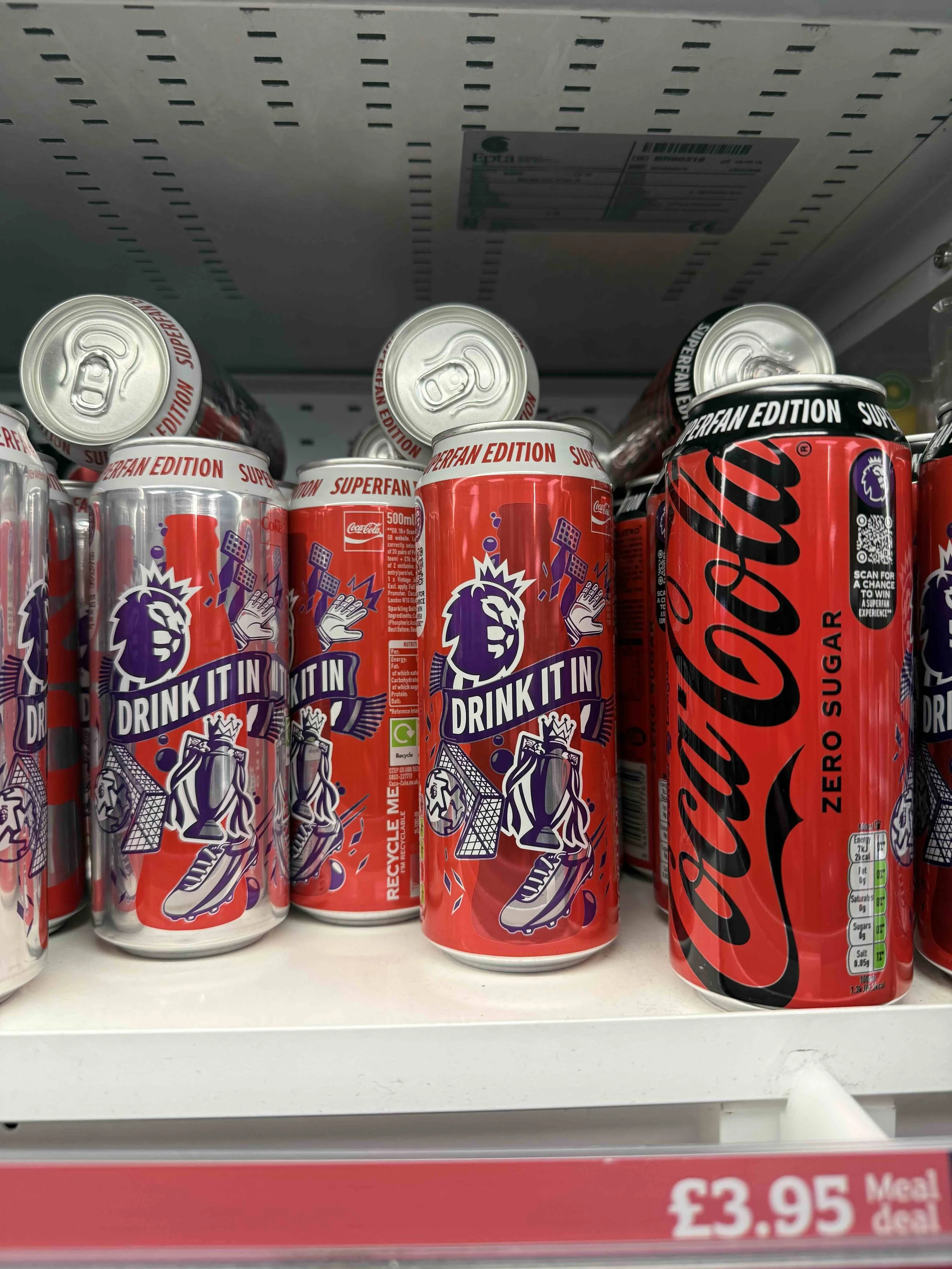
I walked past Coca-Cola on shelf last week and didn’t recognise it.
That sounds ridiculous as I write it down. Few brands on earth are more instantly recognisable. Which is exactly why it caught my attention. These were Coca-Cola’s Premier League promotional cans. They happened to be facing the wrong way on shelf and from that angle, most of the familiar brand assets had disappeared. At a glance, it looked closer to Karma Kola than Coke.
And that serves the rest of us mere mortal brand teams a useful reminder of something we can forget: A pack doesn’t just need to work in ideal conditions. It needs to work in real conditions.
And real retail is messy. Shelves get filled quickly. Products get turned back-to-front. Staff are under time pressure. Convenience stores and food-to-go fixtures are not carefully curated brand theatres. They are high throughput working environments. Things get placed fast, and not always with much care.
So any pack design that depends on precise shelf alignment is taking a risk.
So how does it happen? Well, I nearly made that mistake early on in my career….
That risk gets missed because the design often looks convincing in presentation mode. On a slide, with every pack facing front and every unit lined up perfectly, the concept can feel strong, distinctive and visually disruptive. But that is not the same as being robust in market.
I once proposed a carded outer for John Smith’s that used a beautiful tessellated design. Each case linked visually with the next to create one larger branded block on shelf. In a PowerPoint deck, it looked smart. Probably too smart.
It also depended on every case being positioned exactly right. My Director (rightly) rejected it almost immediately. He understood something I was still learning: elegant design is not the same as effective design. If the idea falls apart the moment the shelf gets a bit untidy, it is not fit for purpose.
Since his intervention, I have had a simple test for pack ideas: does it still work when someone puts it on shelf less than perfectly? Because eventually, someone will.
That principle also applies to any distinctive asset system. If recognition relies on everything being presented in one exact way, the system is probably too fragile. Strong brands build in mistakes. They make sure enough recognition cues survive in imperfect conditions.
The best packs don’t need perfect execution to be recognisable. They carry enough of the brand from multiple angles, in multiple contexts, under conditions that are more real world than PowerPoint.